
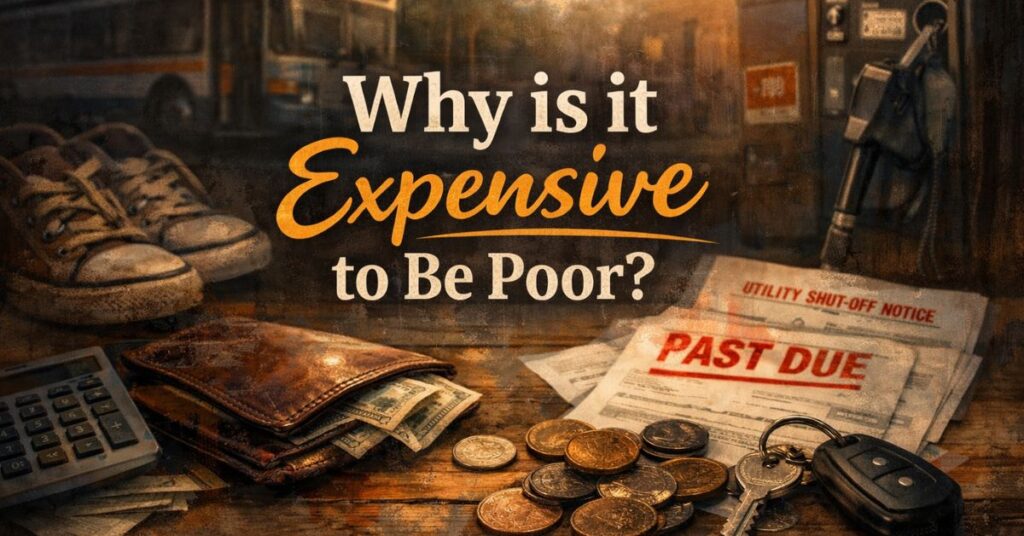
You have probably heard someone ask, “Why is it expensive to be poor?”
I didn’t get it at first.
How can something be expensive when you don’t even have money?
But the more I lived life, the more I started to understand exactly what that meant. It’s not about having money to spend—it’s about how life ends up costing you more when you don’t have enough of it.
If you have ever tried to make your money stretch, make difficult choices, and rob Peter to pay Paul, you probably understand the concept in a real way.
It’s not simply something you hear; it’s something you feel.
What does ‘expensive to be poor’ mean?
It means that you don’t have as many choices when you don’t have a lot of money.
You don’t always get to make the best long-term choice; you pick the choice that works right now.
And sometimes those short-term choices, even if they are required, end up costing more in the long run.
It’s not about being careless.
It’s not about making bad decisions.
It’s about making the most of what you have at the time.
And sometimes, that comes with a cost that builds over time.
Real-Life Examples That Make This Real
Let’s talk about daily life, because this is where it really shows up.
🧥 Getting What You Can Afford Right Now
You might buy something only because it fits your budget right now.
It could be shoes, clothes, or whatever you need for your house.
But things that cost less often:
Wear out more quickly
Break sooner.
Have to be replaced again
So instead of buying once, you end up buying multiple times.
Eventually, that costs more than buying something of better quality in the first place.
But the truth is that you didn’t have that choice back then.
You made the best decision you could with what you had.
Fees That Quietly Add Up
When money is tight, even small fees can feel big.
Things like:
Fees for being late
Fees for going overdrawn
Minimum payments that make things take longer
You’re not trying to get behind; you’re trying to keep everything together.
But those extra fees steadily take away from what you really need.
And over time, it can seem like you’re paying to stay in the same place.
🛒 Buying Smaller Amounts Instead of Saving
We all know that buying in bulk is cheaper.
But when you don’t have extra money upfront, that’s not always possible.
So instead:
You buy less at a time.
You pay extra for each item.
It’s not because you don’t understand how to save money.
It’s because you don’t always have the flexibility to do it that way.
And that’s how the cycle goes on and on without you even knowing it.
🚗 Transportation Challenges
Transportation is another area where the issue shows up.
Without a reliable car, you may have to do the following:
Get on the bus.
Pay for rides.
Plan your day around your limited schedules.
People don’t always know how much time, energy, and occasionally money it costs.
It can also make it harder to get jobs, make appointments, and even run routine errands.
Getting groceries might even become a job that needs planning and extra work.
The Emotional Side No One Talks About
This is the part that doesn’t always get said out loud.
This kind of life can make you feel:
Stressful
Frustrating
Mentally draining
You’re always thinking the following:
What needs to be paid first?
What can wait?
What can I go without?
And sometimes it seems like no matter how hard you try, you’re still just fighting to keep afloat.
Not getting ahead, but getting by.
That feeling can weigh on you.
And over time, it might make you feel stuck, even when you’re doing your best.
But This Is Not Where Your Story Ends
Even though all of this is real, I don’t believe this is where the story ends.
Because I learned something important:
👉 You can be in a difficult place and still be moving forward at the same time.
Progress doesn’t always look big or obvious.
Sometimes it looks like quiet changes that only you can see.
A Faith-Filled Way of Looking at Things
One thing I hold onto is this:
God sees everything.
He sees:
The effort you put in
The things you give up
The decisions you make with what you have
Even when nobody else understands what it takes.
There is something powerful about continuing to move forward, even when things are tight.
Even when it seems like things aren’t moving forward.
Even when it seems like nothing is changing right away.
Small Steps Still Matter
You don’t have to fix everything overnight.
Sometimes progress looks like this:
Learning a new skill
Starting something small from home
Saving a little at a time
Making one better decision today
Those small steps may not seem like much, but they add up over time.
And eventually, they begin to change your situation.
Things start to change little by little.
Changing Your Direction Over Time
I’ve learned something really important:
👉 Your current situation does not have to be your final destination.
You can grow.
You can build.
You can create something different for yourself.
It doesn’t happen all at once.
But it does happen, one decision at a time, day by day.
And every step forward matters more than you think.
You Are Not Powerless
This is something I had to remind myself.
Even when things are tight… You are not powerless.
You might not be able to control everything.
But you can still
Make decisions.
Learn new things.
Move forward a little bit at a time.
And those little things can add up to major changes over time.
Final Thoughts
Yes, it can feel like it is expensive to be poor.
Yes, it can feel like life costs more when you have less.
But I also believe this:
👉 You can move forward.
👉 You can create change
👉 You can build something better over time.
And most importantly…
👉 You don’t have to stay stuck.
👉 You don’t have to give up.
💛 Closing Line
I may not be where I want to be yet…
But I’m not where I used to be.
If this message encouraged you, you can explore additional faith-based devotionals and printable resources inside the Peaceful Pathway® resource library.
These resources are designed to strengthen your faith, calm your mind, and help you protect your peace during difficult seasons.