
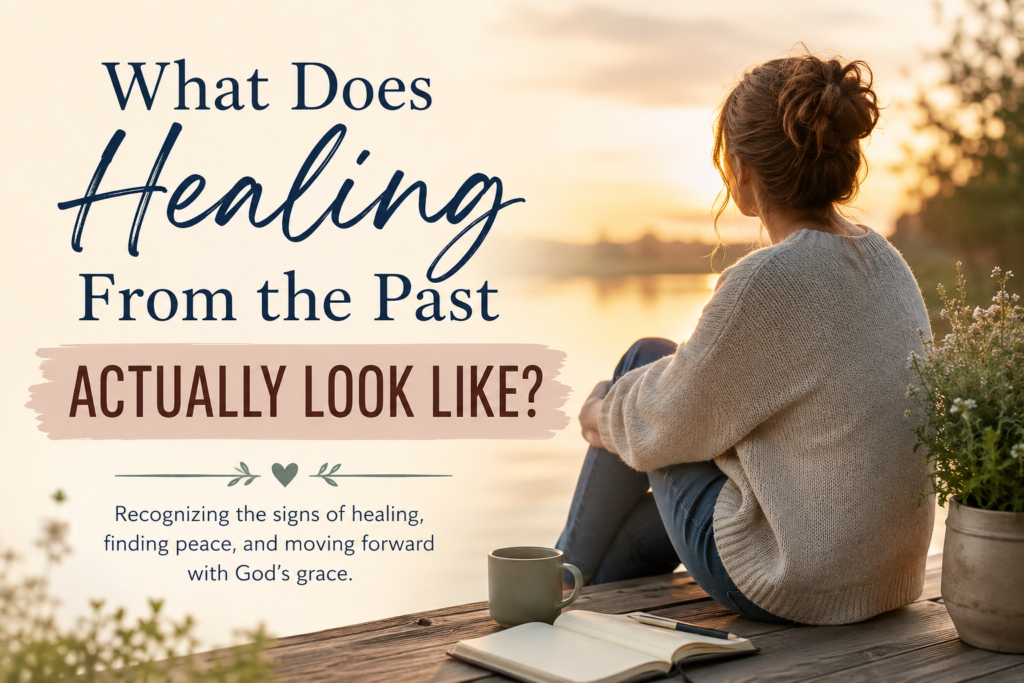
What does healing from the past look like? That’s a question many people ask when they’re attempting to move forward but still feel achy in places they believed would ache less by now.
Sometimes healing sounds simple when people talk about it.
They say things like
let it go
move on
let go of the past
stop dwelling on it
But real healing is usually not that neat.
Healing takes time.
Don’t expect to heal overnight.
It’s quieter than you’d expect.
And it does not always look dramatic from the outside.
This is why so many people become discouraged.
They think:
If I still cry sometimes, maybe I am not healing.
If I still think about it, maybe I am still stuck.
If it still hurts in certain moments, maybe nothing has really changed.
But that’s not always true.
Healing from the past doesn’t mean you forget about it.
It doesn’t mean you never feel anything again.
And it doesn’t mean the story disappears.
Very often, healing looks like less control, more peace, more honesty, and more freedom than you had before.
Healing Does Not Always Look the Way People Expect
Many people expect healing to feel like a breakthrough.
And sometimes God does move in powerful, immediate ways.
But often, healing looks more gradual than that.
It may look like this:
- thinking about something without spiraling the way you used to
- feeling sadness without feeling swallowed by it
- remembering what happened without losing the rest of your day
- being honest about your pain without being ruled by it
- having more compassion for yourself than before
Those things might appear small.
But they’re not small.
They are signs that something is moving within you.
Healing isn’t always loud enough to impress people.
Sometimes it’s just strong enough to transform the way pain lives in you.
Healing From the Past Is Not Pretending It Didn’t Matter
This is important.
Some people think healing means acting like the past did not affect them.
But that is not healing.
That’s denial.
Healing doesn’t ask you to lie.
It does not ask you to call something small when it was painful.
It does not ask you to say you are over it when you are not.
It does not ask you to become emotionally numb just to look strong.
Real healing makes room for truth.
It says:
Yes, that hurt me.
Yes, that changed something in me.
Yes, I still feel it sometimes.
But it doesn’t have to keep ruling my life forever.
That’s a healthy type of honesty.
One Sign of Healing Is That the Past Has Less Control
This can be one of the most obvious signs.
If you’re caught in the past, the present has a way of controlling you.
It may control:
- your mood
- your thoughts
- your confidence
- your relationships
- your peace
- your ability to move forward
But as healing begins, that grip starts to loosen.
You may still remember.
You may still feel sadness.
You may still need grace on certain days.
But the memory doesn’t run everything anymore.
It no longer speaks the loudest word in the room.
That matters.
Because healing does not always mean the wound disappears.
Sometimes it means the wound no longer controls your direction.
Healing Can Look Like New Truth Replacing Old Patterns
Sometimes the past leaves behind something more than pain.
It leaves behind patterns
You might see patterns such as the following:
- blaming yourself too quickly
- expecting disappointment
- assuming people will hurt you
- staying stuck in regret
- replaying what you wish had gone differently
- feeling ashamed for what you didn’t know then
Healing begins to change those patterns
Not all at once.
Not perfectly.
But steadily.
You start learning new truths, like the following:
I did not know then what I know now.
What happened to me is not the whole story of who I am.
I can grieve the past without living there forever.
God can heal places in me that still feel tender.
When truth starts replacing old patterns, healing is happening.
Healing Often Includes Grief
This process surprises some people.
They think healing should feel lighter right away.
But healing often involves grieving.
You might need to mourn the following:
what happened
what should have happened
what you lost
what you never received
what could not be changed
the version of yourself that was wounded in that season
Grief isn’t failure.
It is often part of the healing.
Sometimes tears are not signs that you are moving backwards.
Sometimes they are signs that your heart is finally allowed to tell the truth.
And truth is a part of freedom.
Healing Can Mean You Stop Punishing Yourself
This is a biggie.
There are many who do not just remember the past.
They punish themselves with it.
They say:
I should have known better.
I should have done more.
I should have seen it sooner.
I should not have made that choice.
That kind of self-talk keeps pain alive.
Healing generally starts when you stop talking to yourself like an enemy.
That does not mean you deny mistakes.
It does not mean you call everything okay.
It means you begin to give yourself grace for being human, still learning, still growing, and not having today’s wisdom in yesterday’s moment.
That is not a weakness.
That is mercy.
And mercy is healing.
Healing Looks Like More Peace, Even If It’s Not Perfect Peace
Another sign of healing is that peace starts showing up more often.
Not perfect peace every moment, but more peace than before.
You may notice:
you recover faster from emotional waves
you don’t rehash the same ideas for long
you can talk about some things with less pain
you feel less shame around the memory
you can breathe again where before you merely tensed up
That is healing.
It may not seem dramatic enough.
But do not underestimate what peace is doing in you.
Sometimes peace grows quietly until one day you realize the thing that used to crush you no longer owns you the same way.
Part of healing may also involve making peace with past decisions when regret keeps replaying what you wish had gone differently.
Healing Also Looks Like Better Boundaries With the Past
This may sound strange, but it is important.
Sometimes healing means you stop giving the past unlimited access to your present.
You stop feeding it all day.
You stop replaying it every time you are tired.
You stop letting one old wound tell you who you are now.
That doesn’t mean you don’t think about it.
That means you cease making it the focus of your day-to-day identity.
You start to say:
That happened, but it is not happening right now.
That mattered, but it does not get to control every new day.
That was part of my life, but it is not the whole of my life.
That is a healthy boundary.
Even with the past.
If you want a broader look at how to heal from the past without staying stuck in it, this pillar post can help you see the bigger healing journey more clearly.
What If Healing Feels Slow?
Then it feels slow.
That doesn’t mean it isn’t real.
Healing slowly is still healing.
Healing quietly is still healing.
Uneven healing is still healing.
You are not failing because some days feel stronger than others.
You are not back at the beginning because something touched a tender place.
You are not broken because certain memories still make you emotional.
If tears still surprise you when old memories return, you may also relate to why do I cry when I think about my past and what those emotions may be revealing.
Healing is not a straight line.
It is often more like a path.
And some days on that walk feel lighter than others.
That does not cancel the progress.
Part of healing may also involve making peace with past decisions, especially when regret keeps replaying what you wish had gone differently.
As healing grows, finding peace when you don’t know what’s next can become an important part of learning how to move forward.
What God Does in Healing
One of the most beautiful things about healing is that God does not ask you to do it alone.
He meets you in the places you still avoid.
He meets you in the memories that still ache.
He meets you in the shame you are tired of carrying.
He meets you in regret, grief, and questions that never got clean answers.
And over time, He can do something tender and holy:
He can make the place that once only held pain also become a place of wisdom, humility, compassion, and deeper dependence on Him.
That does not change what happened.
But it does mean pain does not get the final word.
A Gentle Reminder
If you’ve been wondering what healing from the past looks like, this is your reminder:
Healing may look quieter than you expected.
It may look slower than you wanted.
It may not feel impressive from the outside.
But if you have more truth, more serenity, more honesty, more compassion for yourself, and less control from the past than before, healing is happening.
Do not talk yourself out of the progress just because it does not look dramatic.
Sometimes the deepest healing is the type that quietly grows and stays.
Closing Encouragement
Healing from the past does not always mean you don’t cry anymore.
It does not mean you never remember.
It does not mean you are never touched by it.
It means the past is no longer the place to dominate you.
It means the past stops being the place that rules you.
It means your story can still be true without becoming your prison
It means you can carry what happened with more grace, more knowledge, and more freedom than you could have done before.
And that’s beautiful.
Because freedom does not always come by forgetting.
Sometimes it comes by healing enough that memory no longer has the same power
A Short Prayer
Lord, help me recognize the healing You are already doing in me.
Teach me not to measure healing only by whether I still feel pain, but by how You are giving me more peace, truth, and freedom.
Help me stop punishing myself for the past and trust You with the parts of me that are still tender.
Thank You for walking with me in the healing process.
In Jesus’ name, Amen.
If you’d like a little extra encouragement, you can find faith-based downloads and resources in my Peaceful Pathway® store: